Key Takeaways
- A laboratory incubator is judged on two numbers, temperature stability and spatial uniformity. Thermoline builds to ±0.1°C stability and as close as ±1.0°C uniformity.
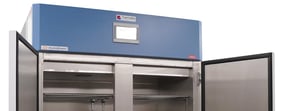
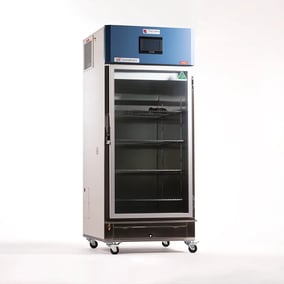
- Three families are made in Australia: benchtop incubators from 20 L to 280 L, premium upright incubators at 520 L and 1,100 L, and premium refrigerated incubators from 145 L to 1,100 L.
- 304-grade stainless steel interiors, Ecofoam insulation and magnetic door gaskets hold optimal conditions steady and keep cleaning simple.
- Every unit is multi-point calibrated, endurance tested and electrical safety tested to Australian standards before it leaves the factory.
A laboratory incubator has one job, and it has to do it perfectly: hold a set temperature, without drift, for as long as your protocol runs. Whether you are growing a microbiological culture overnight, holding cell cultures for a fortnight or conditioning materials before testing, a variation of half a degree in the wrong part of the chamber can quietly undo weeks of work.
At Thermoline, we do not simply assemble incubators. We engineer them, in Australia, with precision, durability and everyday usability designed in from the first drawing. Every decision, from the grade of stainless steel in the liner to the placement of the temperature sensor, is made with one question in mind: will this still hold that same stable temperature on the thousandth day of use?
Here is a look behind the scenes at how that precision is built into every Thermoline laboratory incubator.
Engineering Accuracy: The Science Behind Precise Temperature Control
Temperature control is the foundation of every high-quality lab incubator. For microbiological research, cell culture, pharmaceutical testing or material conditioning, even a slight fluctuation can shift a result. Two specifications matter, and they are not the same thing.
Temperature stability describes how tightly the incubator holds its setpoint over time at a single point. Thermoline incubators control to ±0.1°C. Spatial uniformity describes how evenly that temperature is spread across the whole chamber, top shelf to bottom, front to back. Our benchtop and premium incubators achieve ±1.0°C uniformity in fan-forced mode and ±2.0°C in natural convection at 40°C. A cabinet can look accurate on the display and still be uneven inside, which is why we design and verify for both.
Key features that ensure accuracy
- Omron E5CC and E5CC-T microprocessor controllers apply PID logic to make continuous, fine adjustments rather than crude on-off switching.
- High-precision sensors monitor chamber conditions continuously so drift is corrected before it reaches your samples.
- Engineered heating and airflow paths eliminate hot and cold zones across the full working volume.
- Rapid temperature recovery brings the chamber back to setpoint quickly after a door opening, which is where most real-world excursions actually happen.
- Over-temperature protection acts as an independent safeguard for sensitive samples and for the equipment itself.
Thermoline benchtop incubators also offer something unusual in the Australian market: switchable fan-forced or natural convection. Fan-forced gives you the tightest uniformity for general microbiology and material conditioning. Natural convection avoids air movement across open plates and shallow media, which matters for delicate cultures. Most laboratories buy one incubator and end up needing both behaviours, so we built the choice into a single unit.
Matching the Laboratory Incubator to the Scientific Application
Not every laboratory needs the same cabinet. Capacity, temperature range and whether you need to hold below ambient are the three decisions that shape the specification. Thermoline manufactures three families of laboratory incubators to cover that spread.
|
Range |
Capacities |
Temperature range |
Best suited to |
|
Benchtop Incubators (TI series) |
20 L, 50 L, 80 L, 120 L, 280 L |
Ambient +5°C to +60°C |
Microbiology and bacteriological work, teaching laboratories, general incubation where bench space is limited |
|
Premium Incubators (TI series) |
520 L, 1,100 L |
Ambient +5°C to +60°C |
Clinical and high-throughput laboratories running microbiology, cell culture and molecular biology at volume |
|
Premium Refrigerated Incubators (TRI series) |
145 L, 360 L, 520 L, 1,100 L |
+5°C to +45°C (+10°C to +45°C on the 145 L) |
Work that must sit below ambient: sample storage and testing, culturing, and biological oxygen demand (BOD) testing |
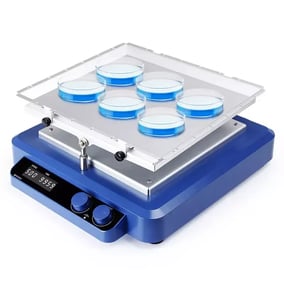
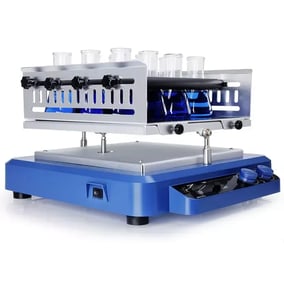
A refrigerated incubator, sometimes called a cooled incubator, is the right answer whenever your setpoint sits near or under room temperature, or whenever an Australian summer means an unrefrigerated cabinet cannot reliably hold 20°C. Thermoline also builds a 200 L shaker refrigerated incubator, the TMLR-200, designed to house a laboratory shaker at a fixed +22°C with an independent external power outlet, for laboratories that need a shaking incubator arrangement without compromising uniform temperature control.
Laboratory Equipment Built to Withstand the Test of Time
Reliability is not a goal we aim at, it is a specification we build to. A laboratory incubator that runs continuously for a decade is exposed to constant thermal cycling, daily door movement and routine chemical cleaning. The materials have to be chosen accordingly.
Durability features you can trust
- 304-grade stainless steel interiors resist corrosion and cleaning agents, and wipe down without pitting or staining.
- Ecofoam insulation minimises heat loss, which keeps conditions stable and running costs down.
- Magnetic door gaskets and heavy-duty seals maintain a consistent seal through thousands of open and close cycles.
- Over-current protection guards the electrical system alongside the over-temperature circuit.
- Robust cabinet construction, with lockable castors on the larger units, stands up to years of daily laboratory use.
Because we design and manufacture at our Wetherill Park facility in Western Sydney, spare parts and service support come from the same team that built the unit. That matters more than any specification sheet when an incubator needs attention five years in.
User-Friendly Design: Simplifying Everyday Lab Work
Laboratory professionals need equipment that is reliable and easy to live with. Thermoline incubators are designed around the person operating them, not just the samples inside them.
User-centric features
- Clear digital temperature displays and simple controller interfaces mean setpoint changes take seconds and minimal training.
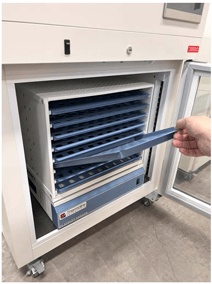
- Adjustable, removable shelves let you reconfigure the chamber for tall flasks, stacked plates or bulky sample trays.
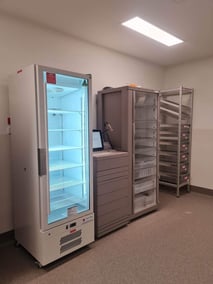
- LED interior lighting on the refrigerated range lets you find a sample without holding the door open.
- Smooth stainless steel interiors with rounded internals make cleaning and decontamination straightforward.
- Glass or solid door options let you choose between visual inspection without opening, and maximum thermal stability.
- Quiet operation keeps the laboratory a comfortable place to work.
Practical options are available too, including door locks, additional shelves and port hole modifications for probes and cabling, so the incubator fits your workflow rather than the other way around.
The Thermoline Quality Promise: Rigorous Testing for Unmatched Reliability
Quality control sits at the centre of our manufacturing process. Before any Thermoline laboratory incubator is packed for despatch, it goes through a full test sequence against our own performance standards.
Our testing process includes
- Multi-point temperature calibration to verify accuracy and uniformity across the chamber, not just at the sensor.
- Endurance testing that simulates long-term, real-world operating cycles.
- Electrical safety testing to comply with Australian standards.
- Over-temperature protection checks to confirm fail-safe operation.
Every incubator is evaluated under real operating conditions to confirm its accuracy, reliability and safety. That is the reason laboratories across Australia, including CSIRO, universities, NSW Health and government departments, specify Thermoline.
Why Choose a Thermoline Laboratory Incubator?

Thermoline has been designing and manufacturing laboratory equipment in Australia since 1970. When you choose a Thermoline incubator, you are investing in:
- Australian design and manufacture, with engineering, production and support under one roof.
- Precise, verified temperature control for results you can defend.
- Durability and low maintenance that deliver long-term value.
- User-friendly design that simplifies daily laboratory workflows.
- Direct access to the team that built your unit, for advice, service and parts.
Specify the Right Incubator with the Team That Builds Them
Choosing a laboratory incubator is easier when you can talk to the engineers behind it. Whether you need a compact benchtop unit for a teaching laboratory, a 1,100 L upright for a high-throughput clinical facility or a refrigerated incubator for BOD testing, the Thermoline team can help you match capacity, temperature range and convection type to the work you actually do.
Contact the Thermoline team on (02) 9604 3911 or get a quick quote today to discuss your application and explore our full range of Australian-made laboratory incubators.
Laboratory Incubator FAQs
Is a laboratory incubator the same as a CO2 incubator?
A standard laboratory incubator controls temperature only, and in some models humidity. A CO2 incubator adds regulated carbon dioxide to maintain the pH of bicarbonate-buffered media, which is required for many mammalian cell culture protocols. If your work does not depend on CO2 regulation, a conventional or refrigerated incubator is usually the more practical and more economical choice.
How often should a laboratory incubator be calibrated?
Most laboratories calibrate annually, though NATA-accredited facilities and those working to a quality system may calibrate every six months or align with their internal schedule. Between formal calibrations, an independent reference thermometer placed in the chamber is a simple way to confirm the controller and the actual chamber temperature still agree.
How much does a laboratory incubator cost in Australia?
Price is driven mainly by capacity, whether refrigeration is required and any customisation such as port holes or additional shelves. A small benchtop unit and a 1,100 L refrigerated cabinet sit at very different points. Thermoline quotes per configuration, so it is worth describing your application rather than shopping by list price alone.
What size laboratory incubator do I need?
Work backwards from the largest item you will incubate and how many you will run at once, then check the shelf spacing rather than the litre figure. Premium models take up to four shelves at 100 mm spacing, which suits stacked plates but not tall flasks. Allow headroom for peak workload, since an incubator packed wall to wall restricts airflow and degrades uniformity.
Can Thermoline incubators be customised?
Common modifications include door locks, extra or repositioned shelves, port holes for probes and cabling, and a choice of glass or solid doors. Because the cabinets are built in Sydney rather than imported to a fixed specification, non-standard requirements can often be accommodated during manufacture.