Key Takeaways
- A temperature and humidity cabinet is a self-contained unit for smaller, highly sensitive items, with tight, precise control and a temperature range up to +80°C, ideal for stability testing and batch storage (Thermoline's Humiditherm range spans 300 L to 1350 L).
- A climate controlled room is a walk-in space, conditioned by ceiling-mounted units, suited to large collections, bulky items, and high-volume climate controlled storage where people, trolleys, or pallets move inside.
- Both regulate temperature and humidity, so the real difference is the size and type of what you are storing, not the control technology itself.
The climate controlled room vs cabinet decision comes down to scale: a temperature and humidity cabinet sits in your lab and you load it through a door, while a climate controlled room is a conditioned space you walk into. Both regulate temperature and humidity to protect sensitive samples, so on paper they look interchangeable.
In practice, matching the wrong unit to the job wastes floor space, strains a budget, or leaves you with climate controlled storage that never fits the way your team works. This guide breaks down what each is built for, where each belongs, and how to choose the right size and type for your facility.
What is the difference between a temperature and humidity cabinet and a climate controlled room?
A cabinet brings controlled conditions to a batch of samples. A climate controlled room brings the same conditions to an entire space you can occupy. One is a precise instrument you load through a door, the other is a working environment you enter.
Temperate-controlled cabinets suit smaller, irreplaceable, or highly valuable items, while climate controlled rooms suit large collections and bulky inventory. If you remember nothing else, remember that a cabinet is something you use, and a climate controlled room is somewhere you go.
What a temperature and humidity cabinet does
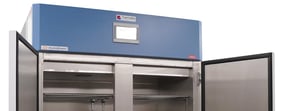
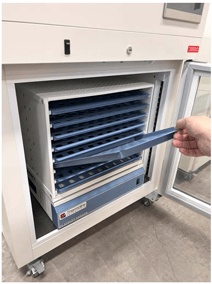
A temperature and humidity cabinet holds tightly controlled conditions inside a sealed, insulated enclosure. Thermoline's Humiditherm (TRH) range operates from +5°C to +80°C across a humidity range of 20% to 90% RH (up to 95% with solid doors), with temperature stability of +/- 0.2°C and humidity uniformity of +/- 5% RH.
That precise control is what makes humidity cabinets the standard for stability and shelf life testing, where a sample sits at an exact set point for weeks and any drift undermines the result. Climate-controlled cabinets provide precise humidity settings and rapid environmental control that a larger space cannot match.
The applications are broad. Pharmaceutical teams run stability studies to confirm shelf life and comply with regulatory submissions. Electronics and aerospace manufacturers validate components, since electronics can rust or short-circuit in high humidity.
Packaging, building-materials, and horticultural labs test durability and germinate seeds under repeatable conditions. Thermoline's humidity cabinets are trusted by organisations including Pfizer, CSIRO, and universities, with an Envirotherm variant for electronics and door-lighting options for observation.
Because a cabinet is a single unit, it is easy to connect. It plugs into a standard supply, fits against a wall or on a bench depending on unit size, and can be relocated if the lab changes. A 316 stainless steel liner resists moisture during humid cycles, while a 10-inch touchscreen handles set points, programmable profiles, alarms, and on-site or remote monitoring, with data exported to USB or Ethernet for audit trails. Four sizes, from the 300 L TRH-300 to the 1350 L TRH-XL, cover a single bench up to higher-throughput work.
What a climate controlled room does
A climate controlled room scales the same idea up to a space you enter. Instead of loading through a door, staff walk in with trolleys and work among the stored items. Thermoline conditions these walk-in rooms with plug-in room conditioning units that slide into the ceiling and lock into place, each housing refrigeration, heating, humidification, and sensors in one self-contained unit, run from a wall-mounted touchscreen.
Each unit conditions 20 to 30 m³, holds +5°C to +50°C and 30% to 90% RH, and runs from a 15A/230V supply. Larger rooms simply take more units, which makes climate controlled storage genuinely scalable: you size the conditioning to the volume rather than being capped by a single cabinet. That capacity suits work a cabinet cannot practically hold, such as bulk storage of vaccines, blood and tissue samples, pharmaceuticals, and bio-products, or walk-in plant growth where researchers move between trays.
Steady humidity regulation across the space also prevents condensation, mould, and mildew on stored stock. Laboratories, hospitals, universities, and agricultural facilities reach for a climate controlled room whenever the volume, the size of the items, or the need to work inside outgrows a cabinet. A useful detail: because these are plug-in units built for pre-assembled structures, an existing cool room can often be upgraded to full temperature and humidity control rather than rebuilt.
Controlled Room Temperature storage for pharmaceuticals
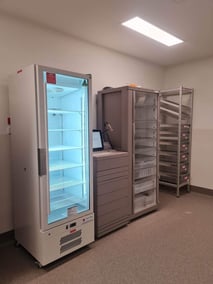
Much regulated stock has to sit at Controlled Room Temperature (CRT), the band that keeps drugs, vaccines, and reagents stable and compliant. A CRT cabinet handles a pharmacy's day-to-day inventory and clinical trials material, holding a consistent temperature and steady humidity levels so shelf life is protected and every batch stays within spec.
When a pharmacy, hospital, or trial sponsor needs to store larger volumes, a climate controlled room delivers the same Controlled Room Temperature conditions across a walk-in footprint. Either way the aim is identical: minimise fluctuations in temperature and humidity, and prevent damage from extreme heat or extreme cold. Independent alarms and remote monitoring flag any excursion before stored inventory is affected.
Climate controlled room vs cabinet: a side-by-side comparison
The clearest way to frame the difference is by the variables that change how you work.
|
Variable |
Cabinet |
Climate controlled room |
|
Scale and access |
Loaded through a door, with capacities from 300 L to 1350 L |
Entered on foot and scales well beyond a single cabinet. If people or pallets need to go inside, that alone points to a room |
|
Temperature range |
Reaches higher, from +5°C to +80°C, for elevated-temperature testing |
Covers +5°C to +50°C, the range that suits storage and living material |
|
Humidity |
Runs 20% to 90% RH (95% with solid doors). For very low humidity work, the cabinet has the edge |
Holds 30% to 90% RH |
|
Precise control |
A sealed cabinet holds tighter uniformity, which is why validation-critical stability testing stays in a cabinet |
A large open room offers less uniformity than a sealed cabinet |
|
Footprint |
Plugs in and can be moved later |
A built structure with conditioning units installed into it |
|
Cost and scalability |
Lower cost and footprint |
Costs more to establish but adds usable working space and scales efficiently once volume is high |
How to choose the right size and type
Start with the items, not the spec sheet. Selecting between the two depends on the size and type of what you store, plus a few practical questions.
- First, how much are you conditioning, and does anyone need to be inside? A handful of sensitive samples points to a cabinet, while bulky items or a workflow where staff move among the stock points to a room.
- Second, what temperature and humidity must you hold? Elevated temperatures near 80°C or very low humidity favour a cabinet. Sitting within +5°C to +50°C and 30% RH or above keeps a room comfortably in range.
- Third, how tight must the control be? Regulated stability testing that hinges on an exact set point favours a cabinet's precise control, while general storage and plant growth tolerate the broader tolerances of a larger space.
- Fourth, where are you heading? A climate controlled room scales by adding units, whereas a cabinet is fixed at its rated capacity. Matching today's choice to tomorrow's volume avoids buying twice.
Why choose Thermaline for your temperature control needs?
The advantage of specifying a cabinet or a climate controlled room with Thermoline is that one team designs, manufactures, and supports both. Every unit is built in Australia at Thermoline's Wetherill Park facility, backed by more than five decades of experience, in-house R&D, and a "right first time" approach to reliability.
Because the humidity cabinets and room conditioning units come from one manufacturer, the recommendation is driven by your application rather than by whatever a supplier happens to stock, and installation, calibration, and after-sales support all come from the people who built the equipment. To weigh your options, the Thermoline temperature and humidity cabinet range and the Thermoline room conditioning units are the place to start, and the team can quote custom sizes or non-standard set points to suit your facility.
Temperature & Humidity Cabinet FAQs
Can I retrofit an existing cool room to add humidity control?
Often, yes. Thermoline's room conditioning units are plug-in systems built for pre-assembled room structures, so a cold store can frequently be upgraded to full temperature and humidity control rather than demolished and rebuilt. The outcome depends on the room's insulation and seals, which is worth confirming before you commit.
How is temperature uniformity checked across a walk-in room?
With a temperature mapping study rather than a single sensor reading. Multiple loggers are placed throughout the space, both empty and loaded, to confirm the conditions hold in every corner, near doors, and at different heights. This mapping is typically part of commissioning and periodic requalification for regulated storage.
What protects stored stock if a conditioning unit fails?
A room sized for several units keeps working if one is taken offline, which a single cabinet cannot offer, and independent alarms flag any excursion early so staff can respond. For critical inventory, that partial redundancy often tips the decision toward a room.
Do cabinets and climate rooms differ in running costs?
They serve different volumes, so the fair comparison is cost per cubic metre rather than a flat figure. A cabinet draws less power outright but conditions only its internal volume, while a room uses more overall yet is usually more efficient per cubic metre at scale. Insulation quality, set point, and door discipline influence both.
Which is quicker to get running?
A cabinet, as it arrives ready to use and needs little more than positioning and commissioning, whereas a climate controlled room involves the room structure and unit installation, so it needs more lead time in exchange for far greater capacity.The climate controlled room vs cabinet decision comes down to scale: a temperature and humidity cabinet sits in your lab and you load it through a door, while a climate controlled room is a conditioned space you walk into.
Both regulate temperature and humidity to protect sensitive samples, so on paper they look interchangeable. In practice, matching the wrong unit to the job wastes floor space, strains a budget, or leaves you with climate controlled storage that never fits the way your team works. This guide breaks down what each is built for, where each belongs, and how to choose the right size and type for your facility.